Types of Private Security Jobs in Oregon – 21 Types
Explore the most common types of private security jobs in Oregon, including hospital security, mobile patrol, loss prevention, armed security, construction site security, event security, gatehouse security, campus security, and more. Learn what each role does and which security career path may be the best fit for you.
Private security jobs in Oregon can look very different depending on the site, shift, employer, and level of responsibility.
Some security jobs involve mega hospitals and healthcare plazas, large industrial complexes, or beautiful corporate campuses.
Some security jobs involve standing in the same place for 8+ hours a day to deter crime, while other security jobs require intense focus on access control, cameras, customer service, or protecting property after hours.
Some Security jobs are as simple as standing around to show presence and deter criminal activity or sitting in a patrol car all night keeping company equipment and vehicles safe from theft and vandalism.
Some Security jobs are as close to being a police officer without actually being a sworn officer. Many sworn officers started their careers in private security work.
It’s a great way to break into the Law Enforcement field.
Many people are looking for private security jobs in Oregon due to the variety of roles available. These private security jobs in Oregon range from hospital security to corporate office security, providing numerous opportunities for those interested in this field.
Security Officers conducting a routine patrol on night shift.
Nightshift often pays a night differential pay between $1 – $5 an hour.
Security is a much broader career field than many people realize. Some security jobs are quiet, routine, and focused mostly on observation, customer service, access control, and report writing.
Other security roles are more active and may involve emergency response, trespassing issues, theft, workplace violence, medical calls, camera monitoring, investigations, and detailed incident reports.
Some security jobs are quiet, routine, and focused mostly on observation, customer service, access control, and report writing. Other security roles are more active and may involve emergency response, trespassing issues, theft, workplace violence, medical calls, camera monitoring, investigations, and detailed incident reports.
Protect people. Protect property. Report what happens clearly and accurately.
Oregon Security Guide
For individuals considering a career change, private security jobs in Oregon can serve as a bridge to more advanced positions in law enforcement or emergency management.
In Oregon, private security work is regulated through the Oregon Department of Public Safety Standards and Training, commonly known as DPSST. If you want to work as a private security professional in Oregon, understanding DPSST licensing is one of the first steps. Read on for more information.
Security Jobs are Vastly Different
Not all security jobs are the same.
An overnight front desk security officer at a quiet office building may have a completely different workday than a hospital security officer working near an emergency department. A mobile patrol officer may spend most of the shift driving between properties, while a loss prevention officer may focus on theft prevention inside a retail store.
That is why it’s important to understand the different types of security jobs before applying.
Some roles are better for beginners. Some are better for people who want action. Some are better for people who prefer low-conflict environments. Others require strong communication skills, physical readiness, report writing ability, and comfort handling stressful situations.
Many of the available private security jobs in Oregon are entry-level, making them an ideal choice for those starting their careers.
Common Types of Security Jobs in Oregon
Understanding the landscape of private security jobs in Oregon is crucial for job seekers as they navigate their career paths.
Security officers in Oregon work in many different environments, including:
Healthcare and hospital security
Retail and loss prevention
Mall and property security
Corporate and office security
Mobile patrol
Industrial and construction site security
School and campus security
Government and public facility security
Transportation security
Event and nightlife security
Armed security
Cannabis security
Security dispatch, CCTV, and SOC monitoring
Various sectors, including healthcare and corporate environments, actively seek candidates for private security jobs in Oregon.
Each type of job has different expectations, risks, schedules, and pay ranges.
Hospital security is one of the more active types of security jobs. Officers may help with access control, patient watches, emergency response, visitor issues, vehicle patrols, and assisting staff during difficult situations.
Hospital security can be rewarding, but it can also be stressful. The pay in healthcare security is on the higher end for private security professionals. Many large hospitals have a pay range starting around $25 an hour for less experienced guards and max out at $40+ for Lead security jobs.
More money often means more problems. Hospital Security Officers may deal with upset patients, intoxicated people, mental health situations, trespassing, theft, and emergency calls. It can also be highly rewarding helping people out who are struggling with life. A little empathy and compassion can turn someone’s frown upside down and possibly change their life for the better.
Common duties include:
Understanding the requirements and training for private security jobs in Oregon can give candidates a competitive edge in the job market.
Patrolling hospital buildings and parking areas
Responding to disturbances
Helping with patient or visitor issues
Writing incident reports
Assisting medical staff when needed
Monitoring cameras and access points
Good fit for: People who can stay calm, communicate clearly, and handle unpredictable situations.
May not be ideal for: Someone looking for a quiet, low-contact security job.
2. Mobile Patrol Security
Mobile patrol officers drive between multiple properties during a shift. These jobs often involve checking doors, walking around buildings, responding to alarms, documenting activity, and making sure properties are secure.
Mobile patrol can be a good fit for people who like being independent and do not want to stand in one place all night.
Common duties include:
Driving a company vehicle between sites
Checking doors, gates, and parking lots
Responding to alarms or calls for service
Removing unauthorized people when required
Writing patrol reports
Taking photos of damage or suspicious activity
Good fit for: People who enjoy working alone, driving, and moving around.
May not be ideal for: Someone who dislikes night driving, paperwork, or handling trespass situations.
3. Construction Site Security
Construction site security is often an overnight position. The main goal is to protect equipment, materials, tools, and the property from theft, vandalism, fire, or unauthorized access.
Some construction sites are very quiet, especially after hours. Others may require regular patrols, gate checks, or dealing with trespassers.
Common duties include:
Watching an empty job site overnight
Patrolling the property
Checking fences, gates, equipment, and trailers
Reporting damage, theft, or safety hazards
Logging visitors or contractors
Calling police or supervisors when needed
Good fit for: People who want a quieter post and do not mind working nights.
May not be ideal for: Someone who wants constant activity or does not like being alone at night.
4. Corporate Office Security
Corporate office security usually involves access control, front desk coverage, camera monitoring, visitor check-in, and after-hours building patrols.
These jobs can be calmer than hospital, retail, or event security. After-hours shifts may involve very little public contact.
Common duties include:
Greeting visitors and employees
Checking badges
Monitoring cameras
Patrolling office areas
Locking or unlocking doors
Responding to building issues
Good fit for: People who are professional, polite, and comfortable working at a desk.
May not be ideal for: Someone who dislikes customer service or front desk responsibilities.
5. Warehouse and Industrial Security
Warehouse and industrial security jobs often involve checking trucks, monitoring employee entrances, controlling access to the property, and watching for theft or safety issues.
Some positions are active, while others are mostly gatehouse or camera-monitoring roles.
Common duties include:
Checking trucks in and out
Verifying driver information
Monitoring cameras
Patrolling loading areas
Watching employee entrances
Reporting safety or security concerns
Good fit for: People who like routine, logs, access control, and working around vehicles or equipment.
May not be ideal for: Someone who does not like repetitive tasks or working in industrial environments.
6. Gatehouse Security
Gatehouse security is common at warehouses, private communities, industrial sites, parking lots, and business properties.
This type of job is usually focused on controlling who enters and leaves a property.
Common duties include:
Checking IDs or badges
Logging visitors, vendors, and trucks
Opening and closing gates
Giving directions
Watching cameras
Reporting suspicious activity
Good fit for: People who want a more predictable security job with clear routines.
May not be ideal for: Someone who gets bored easily or dislikes sitting for long periods.
7. Retail Security and Loss Prevention
Retail security focuses on theft prevention, customer safety, employee safety, and protecting store property. These jobs can range from uniformed security at the entrance to plainclothes loss prevention roles.
Retail security can be more confrontational than many other security jobs because theft, trespassing, and customer issues are common.
Common duties include:
Watching for theft or suspicious behavior
Monitoring entrances and exits
Responding to disturbances
Writing theft or incident reports
Working with store managers
Contacting law enforcement when needed
Good fit for: People who are observant, confident, and comfortable around the public.
May not be ideal for: Someone who wants a quiet post with limited interaction.
8. Mall Security
Mall security officers patrol shopping centers, parking lots, food courts, and common areas. They may deal with shoplifting calls, lost children, trespassing, disturbances, medical calls, and parking issues.
Mall security can be active and public-facing.
Common duties include:
Patrolling the mall and parking areas
Helping customers
Responding to disturbances
Assisting stores with security concerns
Writing reports
Calling police, fire, or medical responders when needed
Good fit for: People who like walking, talking to people, and handling a variety of calls.
May not be ideal for: Someone who wants minimal public contact.
9. Event Security
Event security includes concerts, sports events, fairs, festivals, private events, and entertainment venues. In Oregon, event and entertainment security may have its own DPSST certification category depending on the work and employer. Oregon rules also state that certified armed and unarmed private security professionals are not required to also hold event and entertainment certification to provide security services for event or entertainment venues.
Common duties include:
Checking tickets or wristbands
Screening bags
Watching entrances and exits
Helping with crowd control
Responding to fights or disturbances
Assisting guests
Good fit for: People who enjoy busy environments and can handle crowds.
May not be ideal for: Someone who dislikes noise, crowds, or fast-moving situations.
10. Nightclub and Bar Security
Nightclub and bar security is one of the more confrontational areas of security. Officers may check IDs, manage lines, remove disruptive people, break up fights, and help maintain a safe environment.
This work requires strong communication skills and emotional control.
Common duties include:
Checking IDs
Watching entrances and exits
Managing lines
Removing disruptive guests
Responding to fights or disturbances
Working with managers and law enforcement
Good fit for: People who are confident, calm under pressure, and physically capable.
May not be ideal for: Someone who wants low-stress work or does not like confrontation.
11. Apartment and Residential Security
Residential security officers work at apartment complexes, gated communities, condominiums, and private residential properties.
The job may involve patrols, parking enforcement, noise complaints, trespassing issues, and resident assistance.
Common duties include:
Patrolling apartment buildings and parking lots
Responding to noise complaints
Checking for trespassers
Reporting property damage
Enforcing parking rules
Helping residents with basic security concerns
Good fit for: People who can communicate professionally with residents and handle minor conflicts.
May not be ideal for: Someone who dislikes dealing with complaints or property rules.
12. Campus Security
Campus security jobs may be found at colleges, schools, training centers, and private campuses. These jobs can involve patrols, access control, student or staff assistance, parking enforcement, and emergency response.
Some campus security jobs are calm, while others can be busy depending on the location.
Common duties include:
Patrolling buildings and grounds
Helping students, staff, or visitors
Responding to disturbances
Locking and unlocking buildings
Monitoring cameras
Writing incident reports
Good fit for: People who are patient, professional, and comfortable working around students or staff.
May not be ideal for: Someone who does not like customer service or policy enforcement.
13. Parking Security
Parking security focuses on garages, lots, vehicles, traffic flow, and preventing theft or vandalism.
Some jobs are mostly patrol-based. Others include booth work, payment issues, or enforcing parking rules.
Common duties include:
Patrolling parking garages or lots
Watching for vehicle break-ins
Helping customers
Reporting abandoned or damaged vehicles
Enforcing parking rules
Monitoring cameras
Good fit for: People who like walking, checking vehicles, and working independently.
May not be ideal for: Someone who dislikes outdoor work or parking enforcement conflict.
14. Cannabis Dispensary Security
Cannabis security jobs are common in Oregon because dispensaries often need security presence, access control, and protection for employees, customers, and products.
This work may involve checking IDs, monitoring the lobby, watching cameras, and helping prevent theft or disturbances.
Common duties include:
Checking IDs
Monitoring entrances
Watching for suspicious behavior
Helping maintain a safe lobby
Responding to disturbances
Writing reports when needed
Many private security jobs in Oregon require strong observational skills and the ability to respond effectively in emergencies.
Good fit for: People who are professional, observant, and comfortable in a customer-facing role.
May not be ideal for: Someone who wants no public interaction.
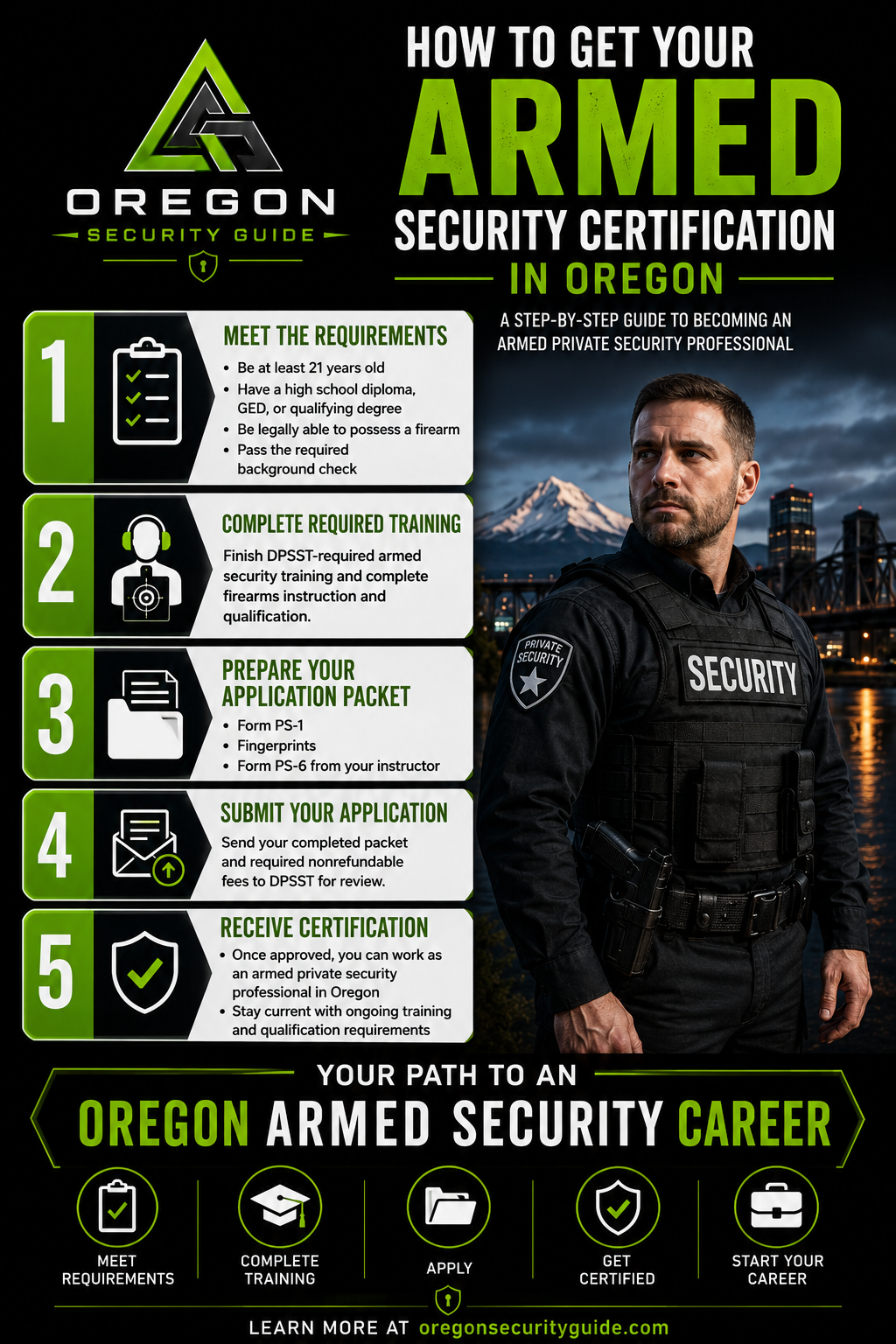
15. Armed Security
Armed security jobs involve carrying a firearm while working. These positions usually come with more responsibility, more training, and higher expectations.
In Oregon, armed private security work requires the proper DPSST certification and firearms training. DPSST lists armed/unarmed professional certification fees separately from unarmed professional certification and includes firearms training requirements in its training and fee information.
Common duties include:
Protecting higher-risk properties
Standing post at sensitive locations
Responding to security concerns
Transporting or guarding valuable property
Writing detailed reports
Following strict firearm and use-of-force policies
Good fit for: Experienced security professionals who are responsible, calm, and well-trained.
May not be ideal for: Someone brand new to security or uncomfortable with the responsibility of carrying a firearm.
16. Executive Protection
Executive protection involves protecting individuals such as executives, public figures, high-net-worth clients, or people facing specific threats.
This is usually not an entry-level security job. It may require experience, advanced training, strong judgment, discretion, and professional appearance.
Common duties include:
Escorting clients
Planning routes
Watching for threats
Coordinating transportation
Maintaining privacy
Responding to emergencies
Good fit for: Experienced security professionals with strong awareness, professionalism, and communication skills.
May not be ideal for: Someone looking for a simple entry-level post.
17. Alarm Response Security
Alarm response officers respond to burglar alarms, property alarms, or security calls. These jobs may overlap with mobile patrol.
This work often happens at night and may involve checking buildings after an alarm is triggered.
Common duties include:
Responding to alarm calls
Checking doors and windows
Looking for signs of forced entry
Contacting police or supervisors
Documenting the response
Securing the property when possible
Good fit for: People who can work independently and stay calm during unknown situations.
May not be ideal for: Someone who dislikes uncertainty or night calls.
18. Security Dispatch / SOC Operator
Security dispatch and Security Operations Center jobs are more computer-based. These roles may involve monitoring cameras, answering phones or radios, dispatching officers, tracking incidents, and documenting activity.
This can be a good path for people who like security but prefer less physical work.
Common duties include:
Monitoring cameras and alarms
Answering security calls
Dispatching officers
Tracking incidents
Writing logs
Communicating with police, fire, medical, or internal teams
Good fit for: People who are organized, calm on the phone, and good with computers.
May not be ideal for: Someone who dislikes multitasking or sitting at a desk.
19. Alarm Monitor
Alarm monitor positions focus on monitoring alarm systems and contacting the appropriate response when an alarm is triggered.
In Oregon, DPSST has an Alarm Monitor Professional certification category listed separately from unarmed and event certifications.
Common duties include:
Monitoring alarm signals
Calling customers or emergency contacts
Dispatching police, fire, or security response
Documenting alarm activity
Following company procedures
Good fit for: People who want a security-related job that is more desk-based.
May not be ideal for: Someone who wants to be physically active during work.
20. Security Supervisor
Security supervisors oversee officers, schedules, posts, reports, and site operations. Some supervisors are hands-on, while others mostly handle paperwork, training, and client communication.
This is usually a step above entry-level security.
Those interested in private security jobs in Oregon should consider obtaining relevant certifications to enhance their employability.
Common duties include:
Supervising security officers
Reviewing reports
Handling call-offs or scheduling issues
Training new officers
Communicating with clients or managers
Responding to serious incidents
Good fit for: People with experience, leadership ability, and strong communication skills.
May not be ideal for: Someone who does not want responsibility for other employees.
21. Field Manager or Account Manager
Field managers and account managers usually work above the supervisor level. They may oversee multiple sites, meet with clients, handle staffing issues, and make sure contracts are being followed.
These jobs can be stressful but may offer better pay and career growth.
Common duties include:
Managing multiple security sites
Meeting with clients
Handling officer performance issues
Reviewing staffing needs
Responding to major problems
Supporting supervisors
Good fit for: Experienced security professionals who want to move into management.
May not be ideal for: Someone who wants a simple post with limited responsibility.
Best Security Jobs for Beginners
For someone new to security, the best starting jobs are usually the ones that provide structure, training, and manageable expectations.
Good beginner options may include:
Corporate office security
Gatehouse security
Construction site security
Warehouse security
Apartment security
Campus security
Entry-level hospital security
Event security
If you are brand new, look for employers that clearly explain the post duties, provide training, and help you understand DPSST require
Security Guard Wages in Oregon
Security wages in Oregon vary by location, employer, shift, and assignment type. Entry-level unarmed security jobs often start around $18-$20 per hour, while hospital security, mobile patrol, armed security, and higher-responsibility posts often pay between $25 – $32 to start and top out at $40+ an hour and potential overtime pay.
In the Portland area, many security guard listings are around $20–$25+ per hour to start, with armed roles often hovering around $25 – $32 to start. Dispatchers are an auxiliary security roll that offers around $20 – $30 to start. Many dispatch jobs require either an alarm monitoring certification or an unarmed security certification.
Oregon Security Guide is here to guide you to which jobs tend to pay more, what certifications may help, and how to move beyond basic entry-level posts.
Current wage references: Oregon’s Portland metro minimum wage is $16.30/hr through June 30, 2026; Indeed lists Portland security guard pay around $21.40/hr and Portland armed security officer pay around $25.88/hr; ZipRecruiter lists Oregon security guard average pay around $20.21/hr.
Lower-Activity Security Jobs
Some security jobs may be lower activity than others. These roles often involve access control, monitoring cameras, checking in visitors, performing scheduled patrols, and writing basic reports.
Examples may include:
Overnight front desk security
Office building security
Warehouse gate security
Construction site security
Lobby security
Camera monitoring or dispatch roles
These jobs may be a good fit for people who prefer routine work, quieter environments, and less frequent confrontation.
Higher-Activity Security Jobs
Other security jobs can be much more active and stressful.
Examples may include:
Hospital security
Emergency department security
Loss prevention
Nightclub or bar security
Mobile patrol alarm response
Transit security
Armed security
Behavioral health security
These jobs may involve more walking, faster decision-making, conflict de-escalation, emergency response, and detailed incident reporting.
They can also offer better experience and, in some cases, higher pay.
Armed vs. Unarmed Security in Oregon
In Oregon, private security work is generally divided into unarmed security and armed security.
Most people start with unarmed security. Unarmed roles are more common and can include retail, office, hospital, patrol, property, and access control jobs.
Armed security usually requires additional training and comes with greater responsibility. Armed positions may be found in certain government contracts, cannabis facilities, banks, patrol roles, and higher-risk sites.
For most beginners, the best path is to start with unarmed security, gain experience, and then decide whether armed security, hospital security, dispatch, supervision, or another specialty makes sense.
Where to Start
If you are new to security in Oregon, start with these steps:
Understand the difference between armed and unarmed security.
Research the types of security jobs available in your area.
Decide what kind of work environment fits you best.
Apply for beginner-friendly security jobs.
Build your skills in communication, report writing, observation, and de-escalation.
Security can be a stepping stone, a long-term career, or a path into related fields such as emergency management, investigations, dispatch, law enforcement, safety, risk management, or security supervision.
Oregon Security Guide
Oregon Security Guide is an independent resource built to help new and experienced security professionals understand licensing, jobs, training, wages, and career paths in Oregon.
This site is not affiliated with DPSST, the State of Oregon, or any government agency. Information is for general educational purposes only. Always verify licensing requirements with official state sources.
Networking with professionals already in private security jobs in Oregon can also provide valuable insights and opportunities.
To keep up with the demands of the industry, ongoing training for private security jobs in Oregon is beneficial.
In summary, private security jobs in Oregon offer diverse opportunities in various sectors, making them an attractive option for many job seekers.
In summary, private security jobs in Oregon offer diverse opportunities in various sectors, making them an attractive option for many job seekers.