


Can security guards make $100k a year in Oregon?
Yes. It happens—particularly in better-paid specialized security roles—but it is important to understand what that number actually represents.
Most security officers in Oregon are not making six figures. Entry-level contract security can pay far less. But healthcare security, government security, school or university security, armed and specialized assignments, supervisory roles, and jobs with substantial overtime can create a very different income picture.
This article is not a promise that becoming a security guard will earn you $100,000. It is an explanation of how some Oregon security professionals actually get there.
The Short Answer
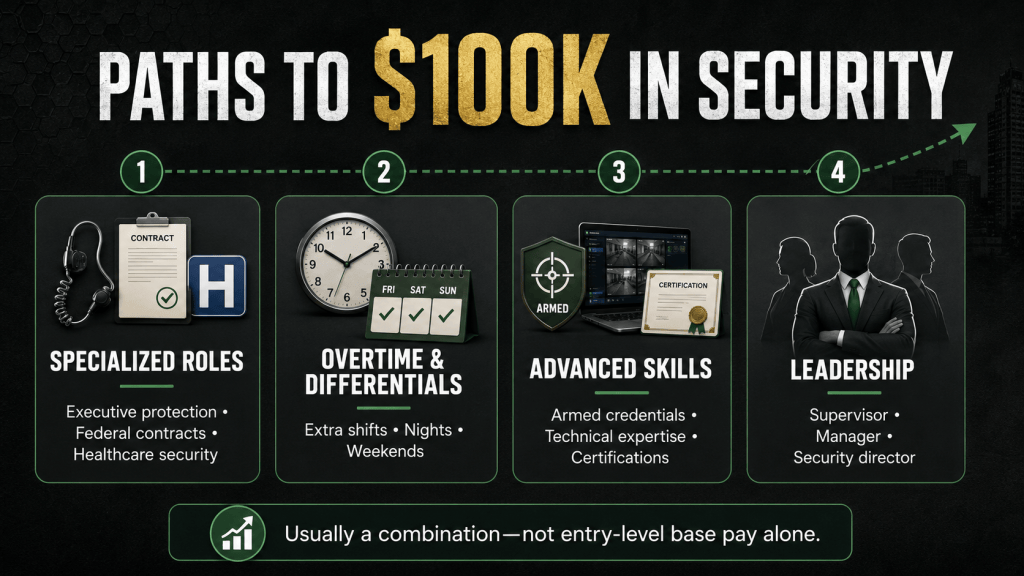
Yes, security officers can make $100K+ in Oregon. The most realistic path is usually not a $100,000 entry-level base salary. It is a combination of a strong hourly wage, specialization, overtime, night or weekend differentials, holiday premiums, and sometimes supervisory responsibility.
At $42 per hour, for example, a standard 40-hour workweek works out to about $87,360 per year before overtime. It does not take an extraordinary amount of additional compensation to cross $100,000 from there.
What I See Working in Oregon Security
I work in the Oregon security industry, and this is where the six-figure discussion becomes more than a theoretical salary calculation.
I personally work around a handful of security officers earning roughly $42 an hour before overtime. With overtime and additional compensation, multiple officers in specialized roles are clearing $100,000 a year. I have also seen officers reach well into the mid-$100,000 range when they work significant overtime.
That does not mean $100,000 is the normal salary for an Oregon security guard. It means the ceiling in certain parts of this industry is much higher than the stereotype of a low-wage guard job suggests.
Important context: The pay examples in this section are firsthand observations from my own work environment. They are anecdotal examples, not statewide averages or guaranteed earnings.
Where Are the $100K Security Jobs?
Six-figure earnings are more plausible in specialized environments where employers need experienced officers, operate around the clock, pay higher base rates, or regularly have overtime available.
Hospital & Healthcare Security
Healthcare security can be a legitimate long-term career rather than simply a stepping stone. Officers may respond to behavioral-health incidents, workplace violence concerns, disruptive patients or visitors, emergency codes, access-control issues, and other situations that require strong communication and de-escalation skills.
Some healthcare employers combine comparatively strong hourly wages with night differentials, overtime, holiday pay, benefits, and advancement opportunities. That combination can put experienced officers into six figures without requiring an executive-level job title.
Government Security
Government facilities and public-sector security positions can offer stronger compensation packages than basic contract guard posts. The details vary significantly by agency and position, so applicants should compare the actual wage scale, benefits, union status where applicable, and overtime rules.
Keep an eye on Oregon Security Guides Job Board for new opportunities or head straight to Government Jobs.
Schools, Colleges & Universities
Educational institutions can employ security, campus safety, public safety, and related personnel directly. Some positions offer competitive wages and benefits, particularly as officers gain experience or move into lead and supervisory roles.
Armed & Specialized Security
Specialized armed contracts, critical-infrastructure assignments, protective work, technical security, and certain high-responsibility posts can pay substantially more than general unarmed contract security. Higher pay normally comes with higher qualification requirements and responsibility.
Supervisory & Lead Roles
Lead officers, field trainers, supervisors, managers, and specialized coordinators can increase their base compensation while sometimes retaining access to overtime. Moving up does not always mean leaving frontline security entirely.
The Math: How $42 an Hour Becomes $100K+
| Base hourly rate | Approx. annual base at 40 hrs/week | What it means |
|---|---|---|
| $25/hr | $52,000 | Would require substantial additional earnings to reach $100K |
| $30/hr | $62,400 | Strong overtime can materially raise annual earnings |
| $35/hr | $72,800 | Overtime/differentials can move total compensation much higher |
| $40/hr | $83,200 | $100K becomes much more attainable with additional compensation |
| $42/hr | $87,360 | Only $12,640 in additional gross earnings is needed to reach $100K |
At $42 per hour, overtime paid at time-and-a-half would be $63 per hour. An officer does not need to work every waking hour to move from an $87,360 base to $100,000, although taxes, scheduling, overtime rules, and actual hours worked all matter.
The $200K Security Guard Story: A Reality Check
I have heard of one security officer in this environment getting close to $200,000 in annual earnings.
I would not use that example to advertise security as a $200,000-a-year career. It was an anomaly, and the person reportedly worked an extraordinary amount of overtime to get there. Put another way: that was one very tired security guard.
There is a major difference between a $200,000 salary and earning close to $200,000 because you worked an extreme number of hours. The second number can be impressive on a W-2 while still representing a schedule most people would not want to sustain.
The more useful takeaway is not the $200K outlier. It is that experienced officers in the right specialized positions can realistically cross $100K, and some can move well into six figures when higher wages and overtime combine.
Six Figures Doesn’t Automatically Mean a Good Job
Annual income is only one way to judge a security position. A job paying slightly less may be substantially better if it provides a predictable schedule, good health insurance, retirement benefits, paid time off, manageable workload, short commute, and a life outside of work.
When comparing security jobs, look at base hourly rate, guaranteed hours, overtime availability, shift differential, benefits, retirement, schedule, workload, commute, training, and advancement. Do not chase a six-figure number without asking how many hours it takes to produce it.
How to Move Toward Higher-Paying Security Work
- Get properly certified. Make sure you meet Oregon DPSST requirements for the work you want to perform.
- Build real experience. Report writing, communication, de-escalation, emergency response, access control, and sound judgment matter.
- Specialize. Healthcare, government, SOC/dispatch, armed security, mobile patrol, technical security, and supervisory work can create stronger career paths.
- Compare employers, not just job titles. Two jobs called “Security Officer” can have dramatically different pay, benefits, responsibilities, and advancement potential.
- Watch total compensation. A strong benefits package and sustainable schedule can be worth more than chasing every available overtime shift.
So, Can an Oregon Security Guard Really Make $100K?
Yes—but don’t confuse possible with typical.
Many ordinary security jobs will not come close to six figures. But $100K+ is a real outcome for some experienced Oregon security professionals working in higher-paying specialized roles, particularly when strong base wages are combined with overtime and differentials.
The better career goal is not simply “make $100K.” It is to develop enough experience and specialization that you can compete for security jobs with better wages, benefits, schedules, and long-term opportunities—and then decide how much overtime is actually worth giving up your time for.
Compare the Numbers & Current Jobs
Want the broader pay picture? Start with the full Oregon salary guide, then compare current openings rather than relying on generic national salary estimates.
Frequently Asked Questions
Can security guards make $100K a year?
Yes. Some experienced security officers in specialized, higher-paying positions can earn $100,000 or more, particularly when a strong base wage is combined with overtime, shift differentials, holiday premiums, or supervisory responsibilities. It is not typical of entry-level security work.
What security jobs have the best chance of reaching six figures in Oregon?
Healthcare security, government and institutional security, specialized armed work, certain school or university positions, supervisory roles, and other higher-responsibility assignments can offer stronger earning potential. Actual compensation varies by employer and opening.
Can a hospital security officer make $100K?
Yes, it is possible at some employers when a competitive base wage is combined with overtime and differentials. That does not mean every hospital security job pays six figures, so compare the actual posted compensation and schedule.
Can a security guard make $200K?
It is possible as an extreme outlier in unusually high-paying or overtime-heavy circumstances, but it should not be considered a normal security-guard salary. Extremely high annual earnings may represent an extraordinary number of hours worked rather than a $200,000 base salary.
Oregon Security Guide is an independent resource. Pay varies by employer, position, location, experience, schedule, collective bargaining agreement where applicable, and overtime availability. Firsthand examples in this article are anecdotal and are not guarantees of future earnings.


